50W Power Amplifier Using STK084

Posted by: W3Circuits Team on 11:22 in Audio and Music | Comments : 0
This is the circuit diagram of 50W power amplifier circuit which built based on single power amplifier chip of STK084. It's an well-known old IC for audio frequency (AF) amplifier.

50W Power Amplifier Circuit Diagram

50W Power Amplifier Using STK084

This circuit requires dual polarity / split power supply with maximum supply of ± 50. The recommended supply is ± 35 / 2-3A DC current. You may use this split power supply circuit for the amplifier. Use 28V center tap transformer to get about ± 36V output.

Technical Details:

Power output: 50W
RL : 8 Ohm
TDH : 0.2 %
Rin : 52K
Gain : 26.4 dB
Noise : 0.3 mV

Take a note that heatsink is required to be mounted on the power IC since it will going to hot when operated and deliver high power output (high audio volume level).

Source Link: www.w3circuits.com

32W Hi-Fi Audio Amplifier Using TDA2050

Here is a Hi-Fi power amplifier circuit, built with a power IC TDA2050. This circuit will produce a power output up to 32watt. With good sound quality, high power and very low distortion feature, this circuit will be very suitable for simple and cheap audio systems.

32W Hi-Fi Audio Amplifier Circuit Diagram


32W Hi-Fi Audio Amplifier Using TDA2050
TDA2050 Amplifier PCB Design:

32W Hi-Fi Audio Amplifier Using TDA2050

 About TDA2050:

The TDA 2050 is a monolithic integrated circuit in Pentawatt package, intended for use as an audio class AB audio amplifier. Thanks to its high power capability the TDA2050 is able to provide up to 35W true rms power into 4 ohm load @ THD =10%, VS = ±18V, f = 1KHz and up to 32W into 8ohm load @ THD = 10%, VS = ±22V, f = 1KHz. Moreover, the TDA 2050 delivers typically 50W music power into 4 ohm load over 1 sec at VS=22.5V, f = 1KHz.

The high power and very low harmonic and crossover distortion (THD = 0.05% typ, @ VS = ±22V, PO = 0.1 to 15W, RL=8ohm, f = 100Hz to 15KHz) make the device most suitable for both HiFi and high class TV sets.

Source Link: www.w3circuits.com

100 W Bipolar Power Amplifier

This is a basic 100 watt power amplifier designed to be (relatively) easy to build at a reasonable price. It has a better performance (read: musical quality) than the standard STK module amps that are used in almost every mass market stereo receiver manufactured today.

100 W Bipolar Power Amplifier Circuit Diagram

100 W Bipolar Power Amplifier

When I originally built this thing, it was because I needed a 100 WPC amp and do not want any money. So I designed around parts I had in the store. The design is actually a standard format, and I’m sure there are commercial entities that are similar. To my knowledge, it is not an exact copy of a commercial entity, nor am I aware of any patents on topology.See more (Tone Control Circuit Designed Using LM833)

For experienced builders: I am aware that many improvements and adjustments can be made, but the idea was to keep it simple and must do-able by anyone who is a circuit, and has not the patience to do a sloppy job. If friend want Bipolar Transistor power amplifier circuit. , In model HIFI OCL 100W RMS. I think this track should be an interesting choice, this circuit is the use of the key transistor BD317 and BD318 unless transistor number BD139, BD140, BC556 too easy then try to buy when the 35V power source with only then build is not difficult for other details as the result of a few See Circuit.

Input stage is a BC556 transistor, which most of the open loop gain, and on the serene DC voltage stabilizes. This feeds a level shift stage where the voltage swing to (-) track references. The Tran conductance stage is a Darlington, improve frequency high linearity. The BD317, 318 on a rather large collector-base capacity is dependent on voltage. The BD319 presents this low-z and has a C (ob) of only a few of PF, which is effectively swamped by the pole-splitting 220pF cap. The scene is supplied by BC546 active load (current), which is approximately 20 mA. The current, until the BC556 is limited to about 70 mA in the worst cases.See more  (Tone Control Circuit Designed Using LM833)


Tone Control Circuit Designed Using LM833

Using LM833 can be designed a very simple tone control circuit using few external components .For this Lm833 ton control circuit can be used almost any type of operational amplifier if it have high input impedance .The LM833 is a is a dual general purpose operational amplifier designed with particular emphasis on performance in audio systems.See more:1W Audio Amplifier Using NCP2830

Tone Control Circuit Diagram

Tone Control Circuit Designed Using LM833

The ton control from this circuit is based on this operational amplifier from National Semiconductor and two RC filters ( low pass and high pass ) .Using the formula presented bellow we can modify the frequency of the tone control circuit - the cut off frequency of RC filters (low pass and high pass )lm833 tone control formula For the tone control circuit presented in this schematic the frequencies are : fL = 32 Hz, fLB = 320 Hz and fH =11 kHz, fHB = 1.1 kHz.See more( 1W Audio Amplifier Using NCP2830)

1W Audio Amplifier Using NCP2830

This 1w audio amplifier circuit is designed using NCP2830 audio IC manufactured by ON Semiconductor.This audio power amplifier ic designed for portable communication device applications and require few external electronic components.

1W Audio Amplifier Circuit using NCP2830 

1W Audio Amplifier Using NCP2830

NCP2830 is capable to provide 1W continuous output power in 8 ohms load.NCP2830 audio power amplifier main features are : high quality audio (THD+N = 0.04%) , low noise: SNR up to 100 dB, overall system efficiency optimization: up to 89% , Superior PSRR (−88 dB): Direct Connection to Battery , Very Low Quiescent Current 7 mA , Optimized PWM Output Stage: Filterless Capability , Selectable gain of 2 V/V or 4 V/V .

Source Link: www.w3circuits.com

Digital Potentiometer Using DS1669

This DS1669 digital potentiometer circuit can be used for replacing your manual volume control in audio circuits.DS1669 are digital rheostats or potentiometers and provide 64 possible uniform tap points over the resistive range and are available in standard versions of 10K, 50K, and 100K ohms.The IC can be controlled by either a mechanical–type contact closure input or a digital source input such as a CPU
With this circuit we can control sound volume form an stereo audio amplifier.

Digital Potentiometer Circuit Using DS1669


Digital Potentiometer Using DS1669
When the S1 and S2 is push we can modify the level of sound (up or down). This integrated circuit is manufactured by Dallas Semiconductor and it can be use like a potentiometer in many applications like : contrast adjustment for an LCD or for level sound control. This digital volume controller IC is manufactured in dip or soic footprint (8 pins) and can be supply with an voltage between 4.5 and 8 volts DC.

Source Link: www.w3circuits.com

2x6W Stereo Audio Amplifier based LA4440 Power IC

This is the diagram of 2x6W stereo audio amplifier based LA4440 power IC. Actually, the LA4440 can be used in both stereo mode and mono (bridge) mode, but the circuit presented in this post is LA4440 in stereo mode. The recommended power supply is 13.2V, while the maximum voltage rated at 18V.

2x6W Stereo Audio Amplifier based LA4440 Power IC
LA4440 Features:

Built-in 2 channels (dual) enabling use in stereo and bridge amplifier applications.
Dual : 6W´2 (typ.)
Bridge : 19W (typ.)
Minimum number of external parts required.
Small pop noise at the time of power supply ON/OFF and good starting balance.
Good channel separation.
Good ripple rejection : 46dB (typ.)
Low distortion over a wide range from low frequencies to high frequencies.
Small residual noise (Rg=0).
Easy to design radiator fin.
Built-in protectors.
Built-in audio muting function.
Thermal protector
Overvoltage, surge voltage protector
Pin-to-pin short protector

Source Link: www.w3circuits.com

Simple 555 Amplifier

The 555 can be used as an amplifier. It operates very similar to pulse-width modulation. The component values cause the 555 to oscillate at approx 66kHz and the speaker does not respond to this high frequency.

Instead it responds to the average CD value of the modulated output and demonstrates the concept of pulse-width modulation. The chip gets very hot and is only for brief demonstrations.

Simple 555 Amplifier Circuit Diagram

Simple 555 Amplifier

Source Link: www.w3circuits.com


20w Stereo Amplifier (2nd Revision)

This amplifier provides two channels of power up to 20 watts RMS from two line inputs. Ideal for use in computers, because its price / power / complexity is optimal.

20w Stereo Amplifier Circuit Diagram

20w Stereo Amplifier (2nd Revision)

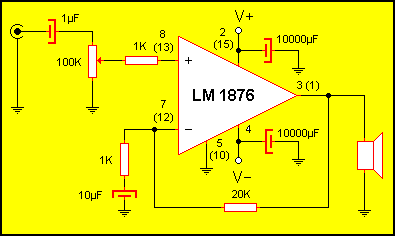
The drawing shows only one of the stages of the system since all circuit both stereo channels are exactly alike. Numbers in parentheses represents the equivalent of the terminal for the second channel. The heart of this project is a circuit from National Semiconductor , the LM1876 , which provides in pill two power operational amplifiers with mute function ( mute ) and standby ( off ) , which we have not implemented this design as an oversimplification .

The incoming signal , after being conditioned , level amplifier enters its non-inverting input . At the end of this part of the resulting signal is reinserted at its inverting amplifier to form the feedback network . Because the circuit is internally balanced when working with power starting not need to install the output capacitor BootStrap.en .

Assembly moduel.

20w Stereo Amplifier (2nd Revision)

Mounted integrated circuit.


20w Stereo Amplifier (2nd Revision)


POWER :

This system requires to operate a voltage of + / -28 Volts and a current of 2 amps. Can be used to obtain the classical source transformer , diode bridge and capacitors.

20w Stereo Amplifier (2nd Revision)

In this case the transformer should have a primary line to line voltage ( 220V) and secondary midpoint for each branch 20v ( 40v from end to end ) . The diodes should be 100V / 3A 1N5406 or equivalent type . Also usable bridge rectifier, which facilitates the task and reduces the number of tracks / space. The filter capacitors are 4700μF x 50v .

Picture of the power supply ( platelet )

20w Stereo Amplifier (2nd Revision)

HEAT SINK :

All key audio system , the heatsink that this time we use is a simple cooler for Pentium III computer . We use this model since it has a surface area greater than traditional metal . To power the vast fan with taking the positive phase of the source and lower your tension with a 7812 regulator dissipated individually.

Source Link: www.w3circuits.com

4X 30W Amplifier Using TDA7386

This amplifier provides a single integrated circuit with few additional components and four independent amplifier channels to assemble a valid multichannel audio system. Based on a chip originally designed for this car audio amplifier is ideal for computers with quadraphonic sound cards like the SoundBlaster Live! Creative Labs Inc. or MosterSound Diamond Diamond Multimedia / S3.

4X 30W Amplifier Circuit Diagram

4X 30W Amplifier Using TDA7386

As seen in the design, the only active component is the TDA7386 IC from SGS-Thomson. This provides four channels of amplification from a single source 12v. The inputs are blocked in DC from 0.1μF capacitors. The mute control terminal and stby may or may not be implemented at the discretion of the owner. The outputs are symmetrical, so that none of the speaker terminals are earthed (both are amplified).

POWER:

Since the entire system is powered by 12v decided, in our case, use a car-stereo source of armed sold and running. You can also armed one to place inside the cabinet. That is up to the owner.

HEATSINK:

Key, should be sufficient to maintain the chip in a suitable temperature. We used a Pentium III cooler with fan running. It is sufficient to connect to Vcc since 12v used as the amplifier.

Source Link: www.w3circuits.com

Simple 1 Watt Amplifier

This circuit can be a line signal as reinforce that you can control with a small speaker.

1 Watt Amplifier Circuit Diagram:

Simple 1 Watt Amplifier

The LM 386 is available in several versions. The LM 386N-1 can deliver a power of 325 mW, the LM 386N-2500 mW, the LM 386N-3700 mW and LM 386N-4, 1 watt power supply. All versions can be used in the circuit.

Using S1 is off. A bass boost (extra bass reinforcement) in the situation shown, the bass boost off.

Parts List:

R1 = 10 k
R 2 = 10 O
P1 = 10 k
C1 = 100 nF
C2 = 47 nF
C3 = 470 uF
C4 = 10 uF
C5 = 33 nF
IC1 = LM 386
S1 = switch

Source Link: www.w3circuits.com

56w Amplifier with Integrated

56w Amplifier with Integrated Circuit Diagram:

56w Amplifier with Integrated

A simple amplifier from the considerable power. Do you think that peak is able to provide well-100W 80v. Particularly cared for the power supply section and shields, as well as providing the integrated a heatsink.

Source Link: www.w3circuits.com

32 Watt Amplifier Using by TDA2050V

A 32 Watt per channel stereo power amplifier made using the TDA2050V monolithic integrated circuit.

32 Watt Amplifier Circuit Diagram

32 Watt Amplifier Using by TDA2050V

Notes:

This circuit is for a 32 Watt stereo audio power amplifier using the TDA20501. With a dual 22 Volt supply this amplifier can deliver 32W into 8 ohm loudspeakers. Moreover, the TDA 2050 delivers typically 50W music power into 4 ohm load over 1 sec at VS= 22.5V and f = 1KHz. The amplifier is cased as a Pentawatt package see pinout below:

32 Watt Amplifier Using by TDA2050V

This is a power amplifier and requires 200mV RMS for full output. Voltage gain is 30.5dB with resistor values shown. Closed loop gain is set by Ratio R1/R2. Increase R2 for less gain and vice versa. Power bandwidth is 20Hz to 80KHz. R3, C3 and R6, C11 form a zobel network to prevent high frequency instability.

The speaker is direct coupled, therefore no expensive large value electrolytics are needed and the bass will be crisp and clean. It is advisable to place fuses in the power supply (not shown).

Parts List:

R1,R4,R5,R8______22k 1/4W Resistor
R2,R7__________680R 1/4W Resistor
R3,R6___________2.2R 1/4W Resistor
C1,C10___________1u NP 25V Capacitor
C2,C12__________22u 63V Electrolytic
C3,C11_________0.47u 400V Polyester
C4,C7,C8,C9_____100n 400V Polyester
C5,C6,C13,C14___220u 63V Electrolytic
U1,U2__________TDA2050V 32W Audio Power Amp

Source Link: www.w3circuits.com

8W Audio Amplifier with TDA2002

W3Circuits could not miss the classic audio amplifier with TDA2002 8w. This amplifier that for years predominated in radios and other auto car mounts.

8W Audio Amplifier Circuit Diagram:

8W Audio Amplifier with TDA2002

The circuit diagram shows that the input signal is blocked in DC across the capacitor of 1μF, then enters the op amp non-inverting input. From the exit take a part of the signal back into the system through the inverting input. The full signal is output continuously removed through 1000μF capacitor and is applied to speaker whose impedance shall be 4 ohms. By placing a speaker of 8 ohms total power obtained is 4 watts.

The circuit is supplied with 12V and requires a current of 1A at full power.

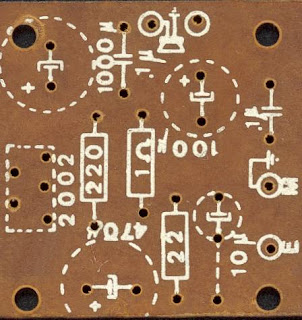
This is the negative mask of the PCB to do with photoresist.

8W Audio Amplifier with TDA2002

And this is the position of each component on the board.

8W Audio Amplifier with TDA2002

This form can be done on phenolic plate smoothly. You can also choose to build it on a printed circuit board type universal pass 5mm islands.

Source Link: www.w3circuits.com

How To make a Sixties-Style 40W Audio Amplifier

In the early 1960s RCA brought out a transistor that was to become truly legendary: the 2N3055. With a pair of these devices, you could put together an audio power amplifier that could deliver a healthy 40 W into 8 Ω. The circuit described here is fully in tune with the spirit of that era.

For example, there are only seven active components in each channel, which reflects the design simplicity typical of that era (and actually a timeless quality). This ‘retro’ power amplifier pumps 45 W into 8 Ω with an input signal level of 0.5 Vrms. It works as follows: the input signal is applied to the base of T1, while negative feedback from the output, attenuated by voltage divider R5/R6, is applied to the emitter of T1. The collector current of T1, which is proportional to the difference between the input and feedback signals, is fed to the base of T2.

This transistor draws its operating current through R8 and R9 and provides voltage gain. Capacitor C6 is a bootstrap capacitor that hold the voltage across R9 nearly constant, so that the current through R9 is independent of the amplifier output signal level in the audio band. Transistors T4–T7 form a quasi-complementary push-pull output stage. In the early 1960s, there simply wasn’t any PNP transistor available that was truly complementary to the 2N3055.

Sixties-Style 40W Audio Amplifier Circuit Diagram

How To make a Sixties-Style 40W Audio Amplifier

Designers came up with an ingenious way to get round this problem, which was to use a complementary Darlington pair consisting of a PNP driver transistor and an NPN power transistor. The schematic diagram clearly illustrates what is meant by a quasi-complementary push-pull output stage. Diode D1 provides balanced biasing for the output stage, which helps reduce distortion.

The operating point of the output stage is set and stabilized by transistor T3, which for this reason should be thermally coupled to the output transistors. The amplifier is powered from a single supply voltage at approximately 65 V, which is also ‘typical sixties’. Capacitor C1, with a value of 4700 μF, transfers the signal from the output stage to the load and provides a bit of protection for the speaker in case one of the transistors fails. The amplifier does not have output current limiting. Although this is not a critical shortcoming, a certain amount of caution is advisable. The only protection in this regard is provided by a slow-acting 1.6-A fuse in the supply line, which is intended to limit the damage if anything goes wrong.

Power Supply Circuit Diagram 

How To make a Sixties-Style 40W Audio Amplifier
The power supply consists of a transformer, a bridge rectifier, four small capacitors and a 4700 μF electrolytic capacitor. This is enough to power a two-channel stereo amplifier. The LED is a power-on indicator and is intended to be fitted on the front panel. Assembling the circuit is very straightforward. Transistors T3, T4 and T5 should be fitted with heat sinks suitable for a TO126 package and with a thermal resistance less than 20 K/W. Transistors T2, T6 and T7 should all be fitted on a single heat sink with a thermal resistance of 2 K/W or less, using insulating washers and thermal paste.

Before applying power to the circuit for the first time, set P2 to its maximum value, temporarily replace the fuse with a 47 Ω, 5 W resistor, and connect a voltmeter across R17. Then switch on the power. The voltmeter should indicate 0 V. Now carefully adjust P2 until the voltmeter reads 15 mV, which corresponds to a quiescent current of 50 mA. Then switch off the power and install the fuse in place of the power resistor.

After this, check the voltage across R17 again (with the power on) and if necessary adjust it to 15 mV. This is fun DIY project, cheap and unpretentious. Nevertheless, the sound quality of this amplifier is respectable. The distortion level gives no grounds for complaint. Of course, it’s not a figure with an incredible number of zeros after the decimal point, but the idea here is to brush up on sixties technology.

Source Link: www.w3circuits.com

Simple Audio-oscillator

It is a very simple build a simple Audio-oscillator Circuit Diagram  Project. The circuit`s frequency of oscillation is/= 2.8/ [C1 x (R1 + R2)]. Using the values shown, the output frequency can be varied from 60 Hz to 20 kHz by rotating potentiometer R2. A portion of IC1`s output voltage is fed to its noninverting input at pin 3.

Audio Oscillator Circuit Diagram:


The voltage serves as a reference for capacitor Cl, which is connected to the noninverting input at pin 2 of the IC. That capacitor continually charges and discharges around the reference voltage, and the result is a squarewave output. Capacitor C2 decouples the output.

Source Link: www.w3circuits.com

Hybrid Headphone Amplifier

This is very easy build Electronic Schematic Circuit of Hybrid Headphone Amplifier Circuit. Potentially, headphone listening can be technically superior since room reflections are eliminated and the intimate contact between transducer and ear mean that only tiny amounts of power are required. The small power requirement means that transducers can be operated at a small fraction of their full excursion capabilities thus reducing THD and other non-linear distortions. This design of a dedicated headphones amplifier is potentially controversial in that it has unity voltage gain and employs valves and transistors in the same design.

Normal headphones have an impedance of 32R per channel. The usual standard line output of 775 mV to which all quality equipment aspires will generate a power of U2 / R = 0.7752 / 32 = 18 mW per channel across a headphone of this impedance.

An examination of available headphones at well known high street emporiums revealed that the sensitivity varied from 96 dB to 103db/mW! So, in practice the circuit will only require unity gain to reach deafening levels. As a unity gain design is required it is quite possible to employ a low distortion output stage. The obvious choice is an emitter follower. This has nearly unity gain combined with a large amount of local feedback.

Unfortunately the output impedance of an emitter follower is dependent upon the source impedance. With a volume control, or even with different signal sources this will vary and could produce small but audible changes in sound quality. To prevent this, the output stage is driven by a cathode follower,based around an ECC82 valve (US equivalent: 12AU7).

This device, as opposed to a transistor configuration, enables the output stage to be driven with a constant value, low impedance. In other words, the signal from the low impedance point is used to drive the high impedance of the output stage, a situation which promotes low overall THD. At the modest output powers required of the circuit, the only sensible choice is a Class A circuit. In this case the much vaunted single-ended output stage is employed and that comprises of T3 and constant current source T1-T2.

Hybrid Headphone Amplifier Circuit Diagram:


The constant current is set by the Vbe voltage of T1 applied across R5 With its value of 22R, the current is set at 27 mA. T3 is used in the emitter follower mode with high input impedance and low output impedance. Indeed the main problem of using a valve at low voltages is that it’s fairly difficult to get any real current drain. In order to prevent distortion the output stage shouldn’t be allowed to load the valve.

This is down to the choice of output device. A BC517 is used for T3 because of its high current gain, 30,000 at 2 mA! Since we have a low impedance output stage, the load may be capacitively coupled via C4. Some purists may baulk at the idea of using an electrolytic for this job but he fact remains that distortion generated by capacitive coupling is at least two orders of magnitude lower than transformer coupling.

The rest of the circuitry is used to condition the various voltages used by the circuit. In order to obtain a linear output the valve grid needs to be biased at half the supply voltage. This is the function of the voltage divider R4 and R2. Input signals are coupled into the circuit via C1 and R1. R1, connected between the voltage divider and V1’s grid defines the input impedance of the circuit. C1 has sufficiently large a value to ensure response down to 2 Hz. Although the circuit does a good job of rejecting line noise on its own due to the high impedance of V1’s anode and T3’s collector current, it needs a little help to obtain a silent background in the absence of signal.

The ‘help’ is in the form of the capacitance multiplier circuit built around T5. Another BC517 is used here to avoid loading of the filter comprising R7 and C5. In principle the capacitance of C5 is multiplied by the gain of T5. In practice the smooth dc applied to T5’s base appears at low impedance at its emitter.

An important added advantage is that the supply voltage is applied slowly on powering up. This is of course due to the time taken to fully charge C5 via R7. No trace of hum or ripple can be seen here on the ‘scope. C2 is used to ensure stability at RF. The DC supply is also used to run the valve heater. The ECC82 has an advantage here in that its heater can be connected for operate from 12.6 V. To run it T4 is used as a series pass element.

Base voltage is obtained from the emitter of T5. T4 has very low output impedance, about 160 mR and this helps to prevent extraneous signals being picked up from the heater wiring. Connecting the transistor base to C5 also lets the valve heater warm up gently. A couple of volts only are lost across T4 and although the device runs warm it doesn’t require a heat-sink. Link

Source Link: www.w3circuits.com

Precision Headphone Amplifier

This schematic circuit diagram project is a very simple and very good quality Electronic Circuit of  Precision Headphone Amplifier. Designs for good-quality headphone amplifiers abound, but this one has a few special features that make it stand out from the crowd. We start with a reasonably conventional input stage in the form of a differential amplifier constructed from dual FET T2/T3. A particular point here is that in the drain of T3, where the amplified signal appears, we do not have a conventional current source or a simple resistor. T1 does indeed form a current source, but the signal is coupled out to the base of T5 not from the drain of T3 but from the source of T1. Notwithstanding the action of the current source this is a low impedance point for AC signals in the differential amplifier.

Precision Headphone Amplifier Circuit Diagram:

Precision Headphone Amplifier
 Measurements show that this trick by itself results in a reduction in harmonic distortion to considerably less than –80 dB (much less than 0.01 %) at 1 kHz. T5 is connected as an emitter follower and provides a low impedance drive to the gate of T6: the gate capacitance of HEXFETs is far from negligible. IC1, a volt-age regulator configured as a current sink, is in the load of T6. The quiescent current of 62 mA (determined by R11) is suitable for  an output power of 60 mWeff into an impedance of 32 Ω, a value typical of high-quality headphones, which provides plenty of volume.

Precision Headphone Amplifier

Using higher-impedance headphones, say of 300 Ω, considerably more than 100 mW can be achieved. The gain is set to a useful 21 dB (a factor of 11) by the negative feedback circuit involving R10 and R8. It is not straightforward to change the gain because of the single-sided supply: this voltage divider also affects the operating point of the amplifier. The advantage is that excellent audio quality can be achieved even using a simple unregulated mains supply.  Given the relatively low power output the power supply is considerably overspecified. Noise and hum thus remain more than 90 dB below the signal (less than 0.003 %), and the supply can also power two amplifiers for stereo operation.

The bandwidth achievable with this design is from 5 Hz to 300 kHz into 300 Ω, with an output voltage of 10 Vpp. The damping factor is greater than 800 between 100 Hz and 10 kHz. A couple of further things to note: some-what better DC stability can be achieved by replacing D1 and D2 by low-current red LEDs (connected with the right polarity!). R12 prevents a click from the discharge of C6 when headphones are plugged in after power is applied.

T6 and IC1 dissipate about 1.2 W of power each as heat, and so cooling is needed. For low impedance headphones the current through IC1 should be increased. To deliver 100 mW into 8 Ω, around 160 mA is required, and R11 will need to be 7.8 Ω (use two 15 Ω resistors in parallel).

To keep heat dissipation to a reasonable level, it is recommended to reduce the power supply volt-age to around 18 V (using a transformer with two 6 V secondaries). This also means an adjustment to the operating point of the amplifier: we will need about 9V between the positive end of C6 and ground.

R4 should be changed to 100 Ω, and R8 to 680 Ω. The gain will now be approximately 6 (15 dB). The final dot on the ‘i’ is to increase C7 by connecting another 4700 µF electrolytic in parallel with it, since an 8 Ω load will draw higher currents. Link

Source Link: www.w3circuits.com

Wideband Two Pole High Pass Filter

The circuit provides a 10MHz cutoff frequency. Resistor R3 ensures that the input capacitance of the amplifier does not interact with the filter response at the frequency of interest.

Circuit Diagram:

Wideband Two Pole High Pass Filter

An equivalent low pass filter is similarly obtained by capacitance and resistance transformation.

Source: www.w3circuits.com